
ESA Letter Template & Sample: What a Reliable Housing Letter Looks Like
Navigating a rental pet policy requires an authentic, defensible emotional support animal letter template that reflects federal Fair Housing Act guidance. Whether you are reviewing an ESA letter sample to check that your documentation will hold up, or searching for a reliable ESA letter template, our independent state-licensed clinical network provides real evaluations at transparent, affordable ESA letter prices.
- ✓ Licensed Clinician Details
- ✓ Usable Nationwide
- ✓ State-Board Verified Clinicians
- ✓ No Pet Rent Once Approved
Legitimate ESA Letter Example: Key Housing Elements
Reviewing an authentic ESA letter example shows that legitimate documentation is neither an instant certificate nor an ID card. A defensible sample ESA letter follows a formal ESA letter format on the clinical letterhead of an active, licensed professional who evaluated you. Below is the structure that supports a valid Fair Housing accommodation request.
-
1
Clinical Letterhead & Identifiers
Practice name, the clinician's full legal name, license type and number, and their National Provider Identifier (NPI) where applicable. No federal rule mandates letterhead or an NPI, but these make the letter easy for a landlord to verify.
-
2
Provider-Patient Relationship
Explicit confirmation that the clinician has a professional relationship with you involving health care or disability-related services, including a telehealth evaluation, consistent with state licensing rules.
-
3
Disability Confirmation
A statement that you have a mental impairment that substantially limits at least one major life activity, without disclosing your diagnosis or therapy notes. A landlord normally has no need for that detail.
-
4
Animal Nexus & Species Identification
Identification of the specific companion animal (for example, a dog or cat) and confirmation that you need it because it provides therapeutic emotional support that alleviates a symptom or effect of your disability.
-
5
Fair Housing Legal Citations
A reference to the federal Fair Housing Act (42 U.S.C. § 3604(f)(3)(B)) and, where relevant, your state’s fair housing law, framing the letter as support for a reasonable accommodation request. HUD withdrew its 2020 assistance animal notice in 2025, so a current letter should not cite it.
-
6
Verifiable Contact & Signature
The clinician's signature, the letter date, and a direct phone number or email so a leasing office can confirm the letter was issued. Our letters are issued for 12 months; federal law sets no expiration date.
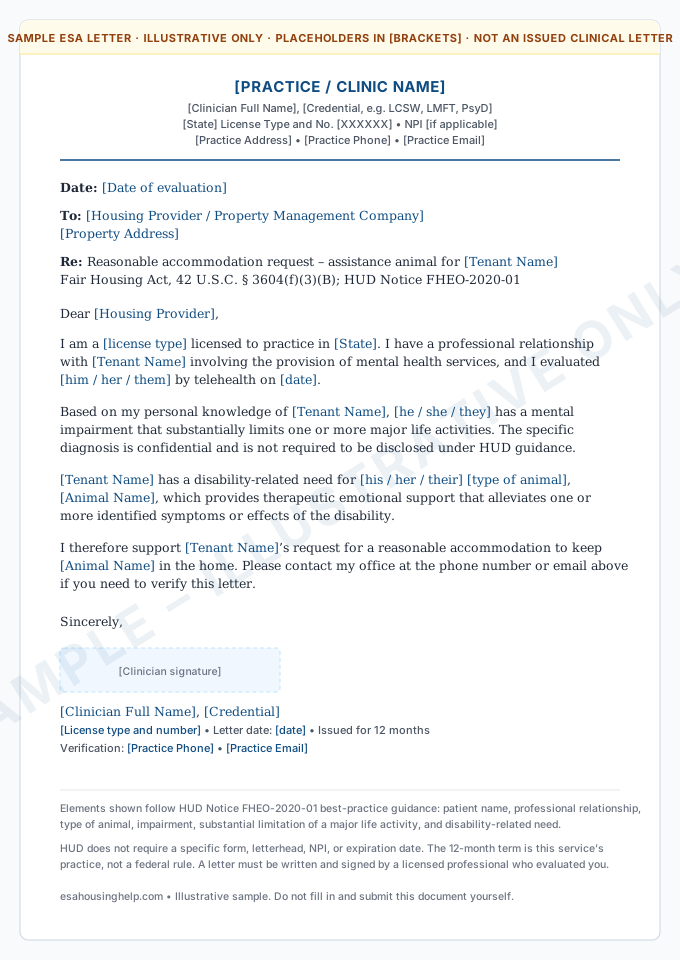
[PRACTICE / CLINIC NAME]
[Clinician Name], [Credential] • License [Type & No.] • NPI [if applicable]
[Address] • [Phone] • [Email]
Date: [Evaluation date]
To: [Housing Provider]
5Re: Reasonable accommodation – Fair Housing Act, 42 U.S.C. § 3604(f)(3)(B)
I am a [license type] licensed in [State] and have a professional relationship with [Tenant Name], whom I evaluated by telehealth on [date].
Confirms a mental impairment that substantially limits a major life activity – no diagnosis disclosed.
Names [Animal Name], a [type of animal], and how it alleviates symptoms.
[Clinician Name], [Credential] • License [No.]
Letter date [date] • Verify: [Phone / Email]
ESA Sample Letter for Rental Housing
Comparing ESA letter samples helps you avoid submitting non-compliant paperwork to your leasing office. Below is an ESA letter sample that follows common documentation practice for fair housing requests. It cites the Fair Housing Act and its regulation, not HUD’s withdrawn 2020 notice. Every name, license number, and date is a bracketed placeholder: it is an illustration of format and wording, not an issued clinical letter, and it cannot be filled in and submitted by a tenant.
Read the sample letter as plain text
Want a letter like this issued in your name?
Only a licensed clinician who evaluates you can sign one. Start with a confidential online assessment.
What Does an ESA Letter Look Like? The 6 Elements Landlords Check
When deciding what an ESA letter should look like, property managers look for specific markers of reliable documentation. A generic printout, a certificate purchased online, or a basic sample of an ESA letter with no licensed clinician behind it will not pass review. No federal rule prescribes a form, but documentation that covers these six points is what housing providers expect to see.
| Element | What Reliable Documentation Shows | Why It Matters for Tenants |
|---|---|---|
| 1. Clinician Identity & Letterhead | The professional's name, practice, and contact details. Letterhead is not mandated, but it makes the source of the letter clear. | Establishes the identity of the examining professional so the landlord can verify it. |
| 2. Active State Licensure | Reliable documentation comes from a licensed health care professional. Telehealth is acceptable when the clinician holds a license valid where you live. | Letters from clinicians not licensed for your state are the most common reason for rejection. |
| 3. Professional Relationship | Whether the professional has a relationship with you involving health care or disability-related services, based on personal knowledge. | HUD’s withdrawn 2020 notice said internet certificates without this relationship were not sufficient on their own, and several state laws, such as Florida’s, say the same. |
| 4. Disability & Need | Whether you have a physical or mental impairment that substantially limits a major life activity, and whether you need the animal because of it. | Establishes qualification under the Fair Housing Act (42 U.S.C. § 3602(h)) without exposing your diagnosis or records. |
| 5. Animal Identification | The type of animal for which the accommodation is sought, and its role in providing therapeutic emotional support. | Links the housing protection to your specific companion animal. |
| 6. Date, Signature & Verification Contact | A dated, signed letter with a way to reach the clinician. Federal law sets no expiration; ESA Housing Help issues letters for 12 months. | Some housing providers ask for current documentation at lease renewal, so a recent letter avoids disputes. |
HUD’s 2020 notice (FHEO-2020-01) described these items as best practice before HUD withdrew it in 2025. They remain a sensible checklist rather than a legal requirement; read what changed in HUD’s guidance.
Landlord Verification Boundaries & Provider Standards
Even when presented with a valid example of ESA letter documentation, some landlords try to impose extra administrative hurdles. Fair housing law limits what a housing provider may ask for, although HUD’s detailed 2020 rules on this were withdrawn in 2025 and state rules vary. Likewise, any ESA letter template for therapist use must comply with state licensing board ethics and HIPAA confidentiality rules.
Fair Housing Authority: What Landlords Can vs. Cannot Do
✓ Landlords can
- ✓Verify the clinician's license on the state licensing board's public database.
- ✓Contact the clinician's office using the details on the letter to confirm it was issued.
- ✓Require the animal to follow standard noise, sanitation, and safety rules, and charge for damage it causes.
- ✓Ask for reliable documentation when the disability or need is not obvious, and request updated documentation if circumstances change.
✕ Landlords cannot
- ✕Demand your confidential medical or therapy records or your diagnostic history.
- ✕Require you to disclose a specific DSM-5 diagnosis or diagnostic code.
- ✕Refuse to consider a letter that already answers their questions just because it is not on their own form or notarized.
- ✕Apply breed, size or weight rules, or charge pet deposits, pet fees or pet rent, for an animal they have approved as an accommodation.
Clinician Telehealth Notice: An authentic ESA letter template for therapist use cannot be signed without a personal clinical evaluation. Housing providers may reject letters from sites that sell instant certificates without a human consultation. Learn more about our credentialed providers in our clinical network directory.
Fair Housing Act Reasonable Accommodation Request Letter Template
This is a different document from the clinician's letter above. When you submit your clinician's recommendation to your leasing office, send it with a written request for reasonable accommodation that you write and sign yourself. Use this pre-formatted ESA letter for landlord template to create a clear paper trail under federal law, and replace every bracketed field with your own details.
Replace every bracketed field, including your animal's name and your unit number.
Attach your clinician's letter. Do not attach or share your diagnosis, therapy notes, or medical records.
Send it by email or a method that creates a dated record. If the request is denied, see what to do next.
Frequently Asked Questions About ESA Documentation
Can I just download a free ESA letter template and fill it out myself?
Can my landlord require my clinician to fill out their own special pet questionnaire?
Can an ESA letter cover more than one emotional support animal?
Is an ESA letter the same document needed to fly with a service dog?
Get a Landlord-Ready ESA Letter Online
Connect with a state-licensed mental health professional in your state. If you qualify, receive documentation on clinical letterhead with the license details a landlord can verify. Backed by our 100% money-back guarantee if you do not qualify.